The French Quarter, or Vieux Carré, is the oldest neighborhood in New Orleans and one of the most recognizable historic districts in the world. Its origins date back to 1718, when the French established the city along the Mississippi River. Over the centuries, it became a cultural crossroads where French, Spanish, African, Caribbean, Native American, and later American influences mixed, creating a tapestry of traditions unlike anywhere else in the United States. The Quarter’s distinctive blend of languages, cuisines, music, and architecture reflects this layered heritage.
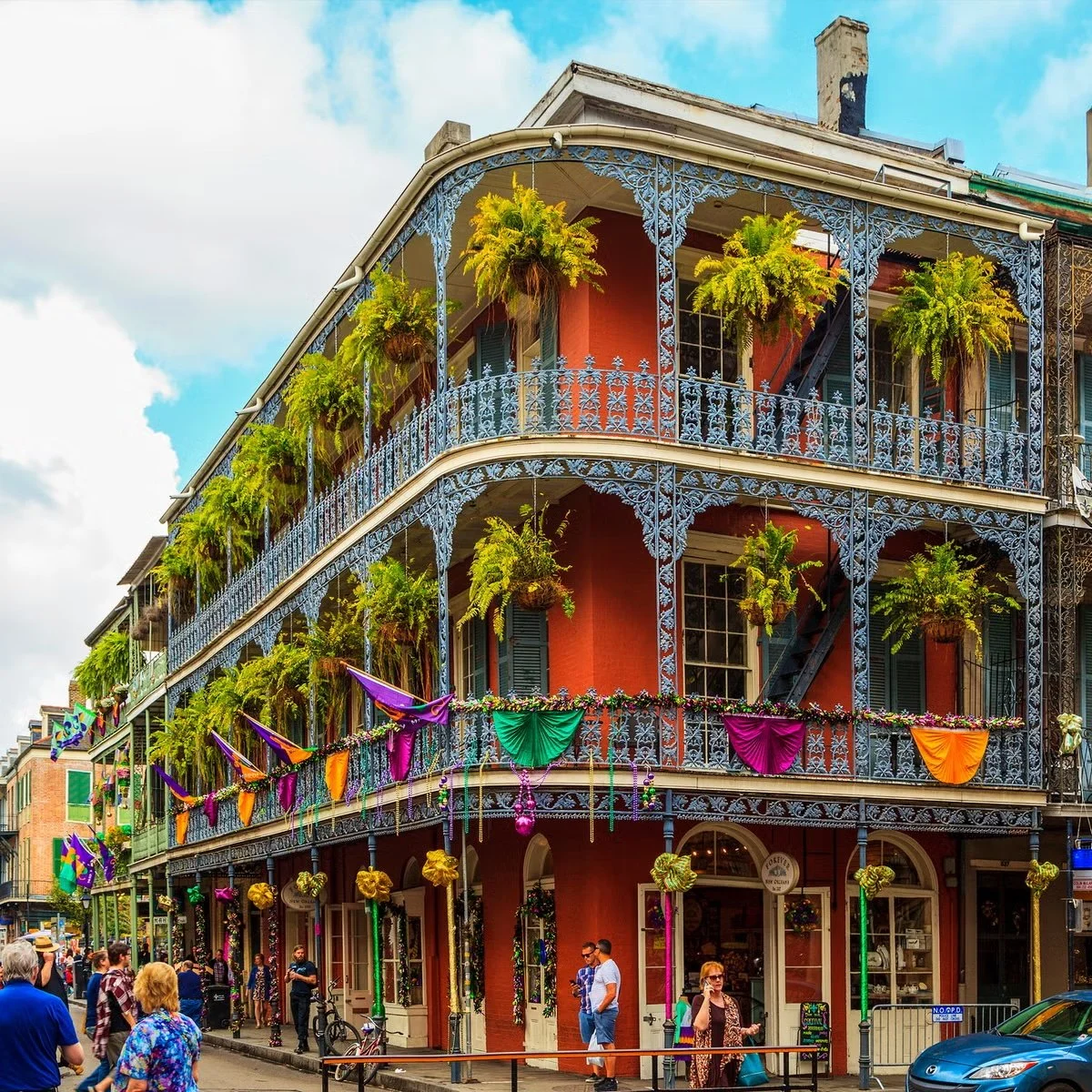
A major turning point in the Quarter’s development came during the late 18th century, when two catastrophic fires destroyed much of the original French wooden structures. The Spanish, who controlled the city at the time, rebuilt the neighborhood using masonry, wrought iron, courtyards, and thick stucco walls. As a result, the Quarter’s architecture today is more Spanish Creole than French, even though the “French” name persists. These distinctive buildings—balconies draped in ironwork, arcades, shutters, and hidden gardens—are a major reason the French Quarter feels timeless.
During the early 19th century, the French Quarter became the stronghold of the city’s French Creole population, who resisted the rapid Americanization that followed the Louisiana Purchase. Napoleon House, the Cabildo, Presbytère, and various Creole townhouses all stand as reminders of a society defined by European refinement, Caribbean influence, and deep-rooted Catholic tradition. This cultural divide—Creole vs. American—shaped not only the Quarter but also the identity of New Orleans as a city with two distinct souls.
The French Quarter also became one of the most important sites of African and Afro-Creole cultural expression, both before and after Emancipation. Free people of color lived, worked, and created businesses throughout the Quarter. The area around Jackson Square connected directly to nearby Tremé and Congo Square, allowing musicians, artisans, and dancers to move freely between neighborhoods. Jazz, the art form that would eventually define New Orleans globally, was shaped in and around these interconnected spaces.
In the late 19th and early 20th centuries, the Quarter experienced a shift as Creole families moved to newer neighborhoods and immigrants—particularly Italian, Sicilian, and Irish—moved in. These communities contributed new traditions, foods, and businesses. The French Quarter’s famous muffuletta sandwich, for example, emerged from Sicilian grocers. Over time, this mix of old Creole families, new immigrant arrivals, bohemians, and artists created a creative, eclectic energy that made the Quarter a magnet for writers and intellectuals like Tennessee Williams, William Faulkner, and Sherwood Anderson.
By the mid-20th century, preservationists recognized the irreplaceable value of the Quarter’s architecture and atmosphere. Their efforts helped establish the Vieux Carré Commission, one of the earliest and strongest historic preservation boards in the country. This move protected the district from demolition and unchecked development, ensuring the survival of its architectural heritage. Today, the French Quarter stands as a model for historic preservation, showing how a living neighborhood can retain its historic character while remaining vibrant and inhabited.
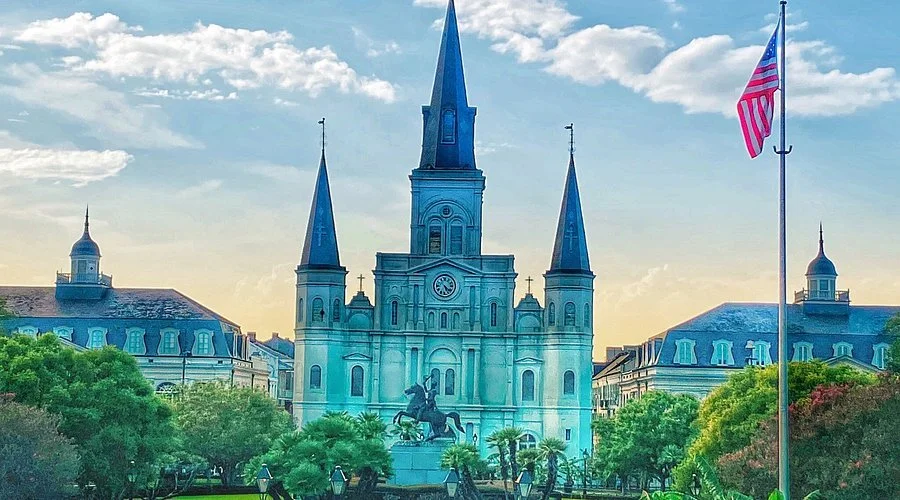
Culturally, the French Quarter remains the beating heart of New Orleans tourism, but it is also much more than that. It is home to enduring traditions such as Reveillon dinners, Mardi Gras celebrations, street parades, brass bands, voodoo practices, and a thriving arts scene. Jackson Square continues to host painters and performers; Royal Street echoes with jazz trios and street musicians; and St. Louis Cathedral remains one of the most iconic religious landmarks in America. The Quarter is simultaneously sacred, festive, chaotic, and refined—an embodiment of the city’s contradictions and charms.
Today, the French Quarter represents the soul of New Orleans: a place where history is not confined to museums but lived on the streets every day. Its balconies, alleyways, and plazas carry the imprint of generations who built, rebuilt, and reimagined the neighborhood. Whether through music drifting from Preservation Hall, the scent of beignets from Café du Monde, or the glow of lanterns along Bourbon Street, the Quarter continues to offer an immersive sensory experience that has captivated visitors and locals for centuries. To understand New Orleans is to experience the French Quarter—its resilience, its beauty, and its endlessly unfolding story.